From VRAM Hacks to AI Agents: The New Frontier of Developer Tooling
As AI coding agents emerge, the developer ecosystem is undergoing a paradoxical shift: we are building sophisticated interfaces for opaque models while simultaneously hacking low-level hardware like Linux VRAM to squeeze more performance from our GPUs.
The Paradox of the Modern Developer: Optimizing Hardware, Trusting Black Boxes
The contemporary software engineering landscape is defined by a fascinating tension. On one hand, we are witnessing the rise of AI coding agents that promise to abstract away complexity, turning code generation into a conversational interface. On the other, developers are diving deeper into the kernel, crafting "hacks" to force Linux systems to utilize GPU VRAM as swap space. This dichotomy reveals a critical truth about the current state of tech: as high-level abstractions grow more powerful, the demand for granular, low-level control intensifies.
The Illusion of the Black Box
For years, Large Language Models (LLMs) were marketed as inscrutable black boxes. However, recent discourse challenges this narrative. As highlighted in discussions around Jay Alammar's work, LLMs are not the black box you were promised. The internal mechanics of attention mechanisms and token prediction are becoming increasingly transparent to those willing to look. This shift is crucial for developers building the next generation of tools.
"Understanding the internals of LLMs is no longer optional for serious engineering; it is a prerequisite for building reliable agents."
This transparency is driving the creation of new interfaces. Projects like Paseo, a beautiful open-source coding agent interface, exemplify this trend. Rather than treating the AI as a magic wand, Paseo and similar tools are designed to make the AI's reasoning process visible and editable. This represents a move away from "prompt-and-pray" workflows toward human-in-the-loop systems where the developer retains sovereignty over the code generation process.
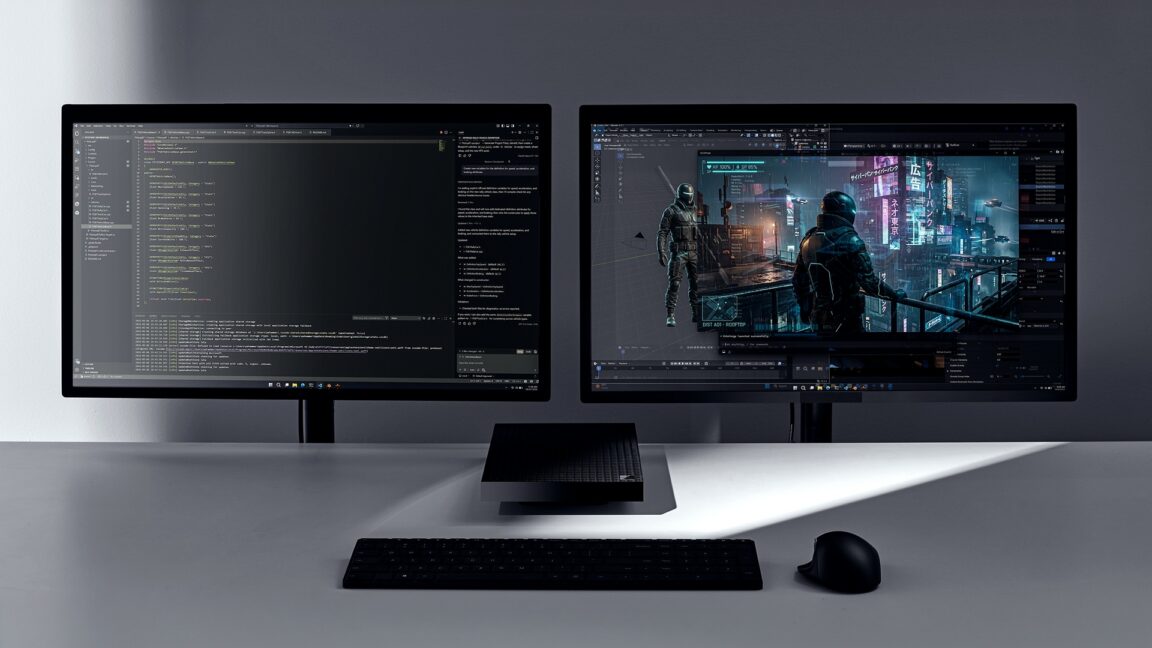
While the image above depicts Microsoft's RTX Spark desktop concept, it symbolizes the convergence of powerful hardware and developer-centric AI interfaces.
The Hardware Reality: VRAM as the New Bottleneck
While the software layer is becoming more conversational, the hardware layer remains brutally unforgiving. The primary bottleneck for running local LLMs and high-performance AI workloads is VRAM. This scarcity has sparked a wave of ingenuity in the Linux community.
The project nbd-vram has gained significant traction on Hacker News for a simple yet profound reason: it allows Linux users to use their Nvidia GPU's VRAM as swap space. This is not merely a niche optimization; it is a survival mechanism for developers running large models on consumer-grade hardware. By offloading memory pressure from the CPU to the GPU, developers can run larger contexts and more complex agents without crashing.
This "hack" underscores a critical reality: software abstraction cannot entirely bypass physical constraints. As AI models grow, the need to squeeze every megabyte of memory becomes paramount. The fact that a GitHub project with a simple utility can garner 84 points and 24 comments on Hacker News illustrates the desperation and creativity of the developer community in the face of hardware limitations.
Microsoft's Hybrid Vision
Amidst this grassroots innovation, giants like Microsoft are attempting to bridge the gap. At the recent Build conference, Microsoft announced plans for Linux tools and a new RTX Spark desktop for Windows developers. This strategy acknowledges the dual nature of the modern stack: developers need the flexibility of Linux for AI workloads but often operate within a Windows-centric ecosystem.
The RTX Spark desktop represents a hardware-software integration that aims to solve the very problems that projects like `nbd-vram` address manually. By providing a curated environment with optimized drivers and Linux subsystems, Microsoft is trying to industrialize the "hack." However, the success of open-source tools suggests that the developer community will always seek to push boundaries beyond what vendor-provided solutions offer.
The Convergence: Context is King
The synthesis of these developments points to a single conclusion: context is the new currency. Whether it is the context window of an LLM or the memory context of a Linux process, maximizing available resources is the primary goal.
1. Transparency: Tools like Paseo and the analysis of LLM internals are moving us toward systems where AI is a collaborator, not a replacement.
2. Optimization: Projects like `nbd-vram` demonstrate that developers are willing to write kernel-level code to ensure their AI agents have enough room to breathe.
3. Integration: Microsoft's moves suggest a future where the OS itself is optimized for AI, blurring the lines between Windows and Linux.
Conclusion: The Era of the Full-Stack AI Engineer
We are entering an era where the "Full-Stack" engineer must be equally comfortable debugging a kernel module to free up VRAM and prompting an AI agent to refactor a microservice. The gap between the "black box" AI and the "bare metal" hardware is narrowing, not because the AI is becoming simpler, but because the developer's understanding of both layers is deepening.
As we look forward, the most successful tools will be those that respect the developer's need for control while leveraging the power of AI. The future of the developer ecosystem lies not in choosing between AI agents and Linux hacks, but in mastering the synergy between them. The black box is opening, and the hardware is being pushed to its limits; the developer is the only one who can hold it all together.